Meniscus
By Emme Rummery
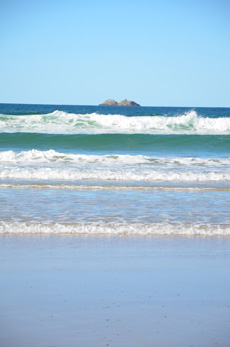
Yellow sand, white, curving waves and a cliff face that looks like a serene, monolithic profile, staring out to sea. My grandmother used to linger at Queenscliff beach until her children begged to go home. The sea was her lodestone. Like a tide, she retreated and returned, drawn by the surf, the hot sand, the scent of sunscreen.
I’ve always been fascinated by stories of selkie skins, legends of siren songs. Myths of obsession, magnetism, the worlds in-between. Even Narcissus was enchanted by the hypnotic, mirror-like effect of light on water. The line dividing the creative and the critical is as slim as changeable as a meniscus, the barrier between light and air.
Instead of swimming during my childhood lessons, I used to hover, belly-up, just beneath the surface of the water, staring at the light that wavered through, moonstone-like. Here and there. Portals and barriers.
If we are what we believe, the wavering border between the creative and the critical is intimately linked to our conceptualization of our own subjectivity and each landscape, fantasy and reality, are vital to our constructions of ourselves.
The dawn Nana Joy died, my father went to the beach and took a photograph of the sun rising on the horizon she’d watched so often. Oranges and pinks in a dark wooden frame in our front hall. Dad also loves the ocean. Some of my earliest memories are of him taking my brother and I out into the deep water, lifting us up on his shoulders and throwing us over the waves. Lying in the warm, shallow swells at the edge of the sea, barely suspended, the sand shifting and dense underneath me, imagining I was a mermaid, imagining I was home. Fifteen years later I’m in Shanghai and the dark, shifting expanse of the Bund is the first large body of water I’ve seen for months. I let out a shaky breath and begin to cry. The sea is my backdrop. I don’t swim in it very often but when I do, I’m immersed. The pressure of it, on every side. Salty and cool, shifting. Lifting me up, throwing me over waves. The ocean is engulfing, embracing. It suspends your body, emotions, disbelief. You become lighter than air, in tangible contact with the world which surrounds you.
After Nana Joy’s funeral I was given a small, half-empty bottle of her perfume, a sample vial of an obscure French scent that spilled all over my jewellery box when I was eight. Now the fragrance I associate with her is mixed with the tang of metal and old velvet, the gold of my Holy Communion necklace, my glass rosary beads. Senses, memory, impressions twirl together and create something new.
Like the ghost of her scent my love of the ocean, the cleansing rush that sweeps through me with every inhalation, is what I’ve inherited from her. I have my other nana’s widow’s peak, her anxiety, her creativity. I have a hint of Grandfather Harold’s smile as well as his sense of humor. I have Grandfather Pete’s love for books and solitude.
Our conceptions of ourselves are dependent upon our environments, but we also know that heredities impact upon the characteristics of an individual. Learned traits or inherited genes passing down through the centuries, coiled up inside my ancestors, who each carried within them, myself. A fragment of who I could potentially be. They are my past incarnation. I’m a patchwork of chance and everything they were.
The notion of body knowing, a mind infused through the skin, blood and bones, speaks of an ancient, primal knowledge. Sensing violin-string tension in a silent room, the safety of the foetal position, the rocking pressure of waves. When I’m underwater my hair turns rose-gold like my dad’s. It always streams away, finds the outgoing tide.
Nana Margaret used to curl up on tree branches, reading, lost in story worlds whilst her six sisters, all beautiful according to family lore, played below. Our house in England had a miniature forest of trees in the front yard. I could climb up into the fork of one and sit there for hours, reading, looking out across our neighbour’s ornamental pond. Maybe before either of us there was a girl who poured over books in the family library, a priest who illuminated scrolls, an old woman who told stories around a fire.
Australia is one giant, living, breathing border culture. Rabbits find their way through the fences no matter what we do. The long lines of barbed wire (ghostlike, still present in black spiky words on the page) follow the undulations of the earth. The landscape is indifferent to our markings. Borders are by definition changeable, non-places, just a fissure between here and there. Australia, as a colonized space, will forever be a border culture to some. It’s riddled with scars and histories that haven’t yet been purged. Australia is a tropical desert, a dusty lush oceanic arid cement jungle of real and not real. From the beginning we were a boat people living on an island of retold histories and forgotten myths.
My great grandfather on Mum’s side was born in 1888. His grandfather, 1840. I am fifth generation Australian, but what does it mean to be Australian? I have no Aboriginal heritage. I can’t claim that this land belongs to me, or I to it. Centuries of my family have lived and died on this island, but the roots of my heritage weren’t born from it. I feel a deep connection to the landscape, the warm, sun-soaked stones, the pale cracklings and intricacies of the bush, the blue expanse of sky. Yet my whiteness makes me a blank piece of paper with the same impermanence, possibility and corruptibility, as the empty word document glowing before me.
Terra Nullius. Land belonging to no one. Myself. Girl belonging to no land. I’m a flag, planted in the red earth, but suspended above, held taut by the wind. The flagpole can’t grow roots. It’s not a trunk.